For a Las Vegas home, begin with the view: a roofline seen from the street, an entrance seen up close, or both. Use the comparison below to narrow your questions before buying replacements or accepting a design.
Swipe the table sideways to compare both columns.
| What to compare | C7 | C9 |
|---|---|---|
| Nominal width | 7/8 inch | 1⅛ inches |
| Common screw base | E12 on traditional replaceable models | E17 on traditional replaceable models |
| Design starting point | A finer scale for entrances, windows and close-view details | A larger shape to consider for broad rooflines and street views |
| Brightness and power | Check the exact product and technology | Check the exact product and technology; larger does not automatically mean brighter |
| Replacement decision | Identify the complete set first. Some C7- and C9-shaped lamps are sealed and not removable. | |
Design uses are starting points, not rules. Sources: sizes and bases, design applications and complete-set differences.
How C7 and C9 Light Bulbs Differ
The traditional C designation describes a cone-style shape. Its number expresses a nominal diameter in eighths of an inch, as explained in Christmas Light Source's size and base reference:
- C7: nominal diameter of 7/8 inch.
- C9: nominal diameter of 1⅛ inches.
Nominal size is a useful starting point, while the specification gives the dimensions of the product you are considering. For example, Bulbrite's C7 model 770171 lists an overall length of 2.188 inches. Its C9 model 770191 lists 2.938 inches. These are named manufacturer examples, not a statement of products supplied by ChristmasLightsLV.
The comparison illustration shows relative widths. Its heights are illustrative. When matching old light bulbs, use the model information and base designation rather than judging a photograph alone.
Choose C7 or C9 for the View You Want
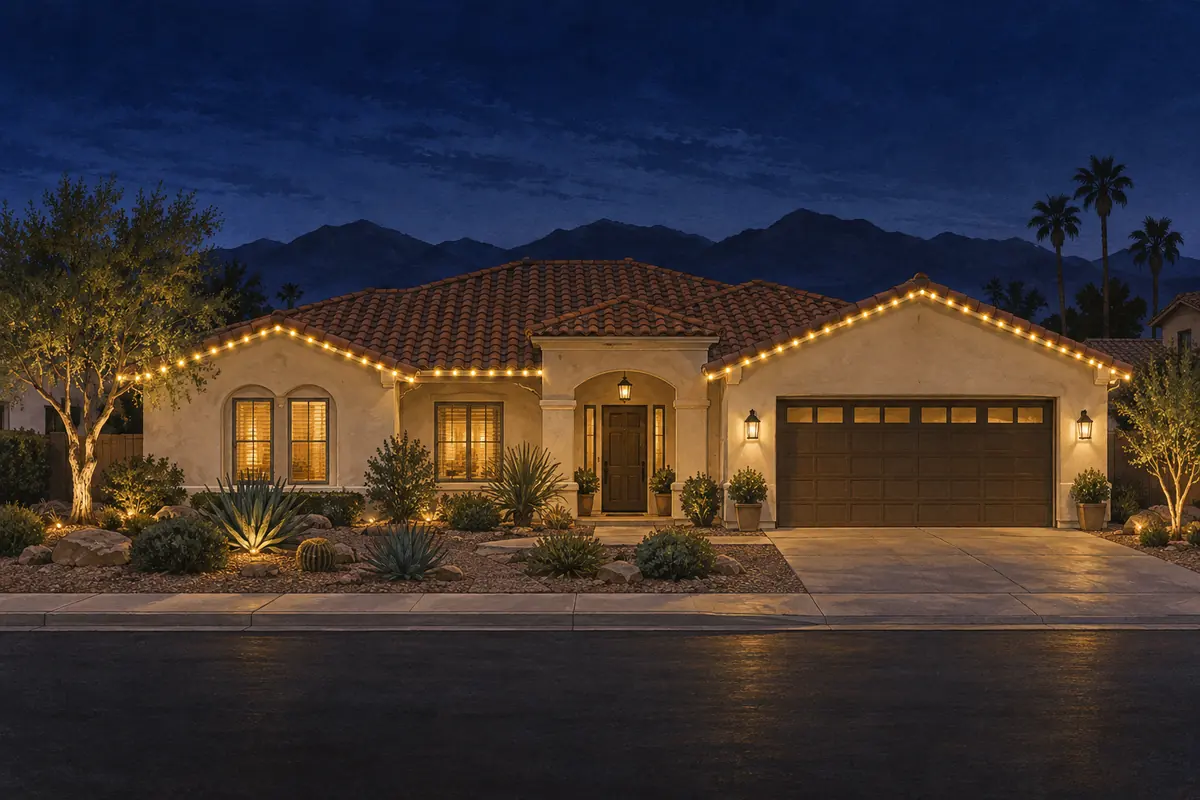
Rooflines Seen From the Street
A larger shape can be a useful starting point for a roofline that forms the main outline of the home. Christmas Lights Etc's application guide associates C9 with rooflines and other larger displays, while describing C7 as a finer scale for details seen nearby.
Treat that as design guidance. A larger lens does not establish greater brightness across different products. Stand at the normal viewing distance, decide which roof edges matter, and ask to compare the proposed lights from that position. The outline, spacing and color should be considered together.
Windows, Entrances and Close Details
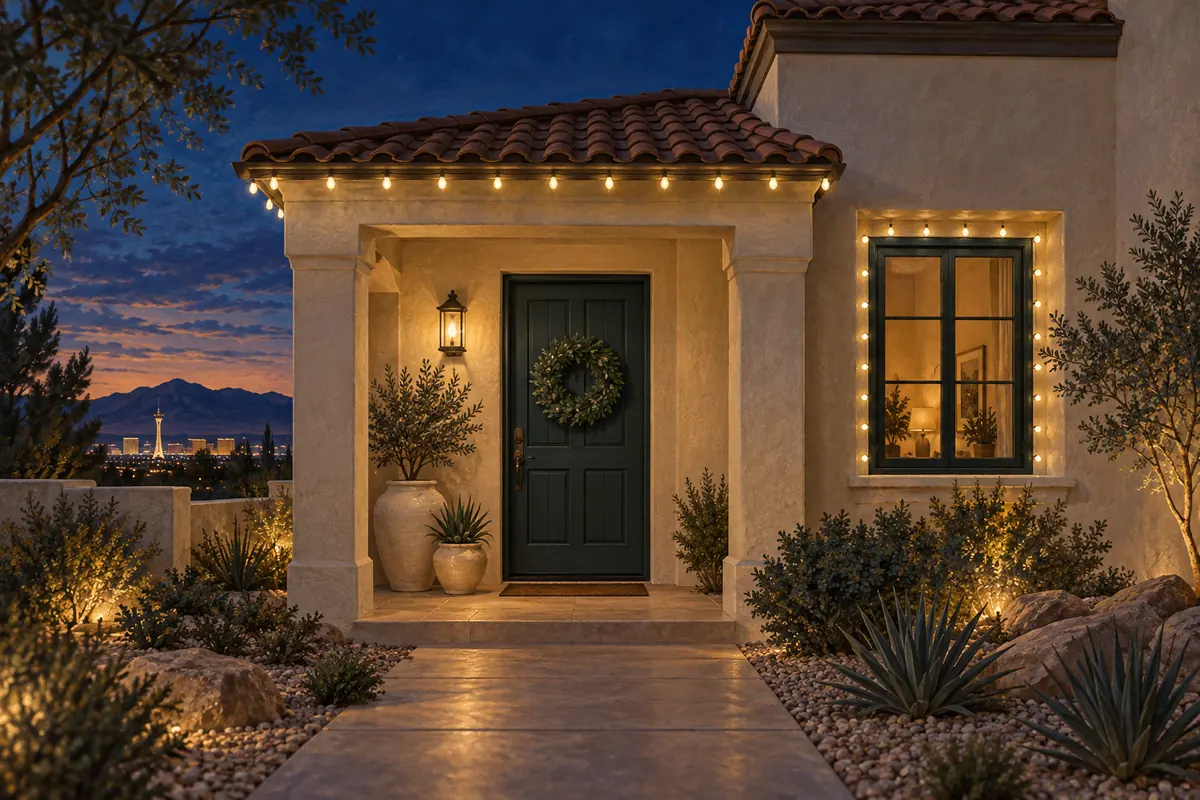
C7 can be worth comparing for a window frame or entrance where guests see individual bulbs nearby. C9 may still fit the look you want; judge the sample against the space rather than treating one size as mandatory.
Mark the roofline and entrance separately on your photo. That lets you compare C9 for a broad outline and C7 for finer details—or one consistent shape for both—without assuming the equipment is interchangeable.
Check C7 and C9 Bases and Complete Sets
E12 and E17 Describe the Screw Base
Common US replaceable C7 bulbs use an E12 candelabra base; common C9 bulbs use an E17 intermediate base. The two screw bases fit different sockets. The named Bulbrite specifications above show those combinations, but the complete product information should control your choice.
If you already own string lights, photograph their label and packaging before choosing replacement bulbs. Check the specified base, voltage and approved lamp type. A match in appearance alone does not establish compatibility. Keep the model number with your lighting notes so next season's replacement request starts with the right information.
For existing holiday lighting, separate two decisions: can the bulbs be replaced under the manufacturer's instructions, and can the resulting set be used in the new design? Ask the installer to confirm both. If the product cannot be identified, keep it out of the assumed materials list until it has been assessed.
Some Sets Have Sealed Lamps
A package can use C7 or C9 to describe the lens shape without containing traditional screw-in bulbs. Christmas Light Source sells a C7 set with non-removable lamps, and its string-versus-retrofit explanation describes a sealed C9 set alongside separate replacement bulbs and cords.
That distinction changes what happens when a lamp needs attention. Ask whether the proposed lights use replaceable bulbs, a serviceable component or a complete set that must be handled according to its instructions. Do not pull apart an unfamiliar set because its outer shape looks like another product.
Compare C7 and C9 LED Bulbs by Energy Use
LED Christmas lights generally use less energy than comparable incandescent bulbs, as the U.S. Department of Energy explains. C7 and C9 describe size, however, so neither name gives you the power consumption of a finished lighting plan.
The two Bulbrite LED examples above are both rated at 0.6 watts despite their different sizes. That is a useful demonstration of why you should read the specification; it is not a standard wattage for all bulbs. A larger C9 can share a power rating with a smaller C7 in a particular range.
For an energy estimate, collect the actual product rating, the number of lights and the intended operating hours. Use a whole-set rating when that is what the manufacturer provides. Compare equivalent areas and schedules, then apply your electricity rate if you want a running-cost estimate. Lower power use by itself does not establish the total cost of installation or seasonal service.
Calculate Energy for Your Christmas Lights
Use the rating that describes what you are counting:
- Per-bulb rating: watts per bulb × number of bulbs × operating hours ÷ 1,000 = kilowatt-hours (kWh).
- Whole-set rating: watts per complete set × number of sets × operating hours ÷ 1,000 = kWh. Do not multiply by the bulbs again.
For a hypothetical example, 100 bulbs at the verified 0.6-watt rating used above, running for six hours, give 0.6 × 100 × 6 ÷ 1,000 = 0.36 kWh for the bulbs. The quantity and schedule are assumptions, not a proposed package. Add any separately powered equipment using its own rating; this estimate does not establish allowed connections or total installation cost.
Illustrative daily energy use for 100 bulbs rated at 0.6 W each. Only the hours change; the bar scale starts at zero.
Calculation: 100 × 0.6 × hours ÷ 1,000. The rating comes from the two named Bulbrite examples above; it is not standard for every C7 or C9. Other equipment and electricity prices are excluded. This shows the effect of operating time, not savings from one bulb size.
Estimate Your Display's Energy Use
Use your equipment's stated input watts and planned schedule. Add the electricity price that applies during those hours if you want an estimated energy charge. C7 and C9 describe size, not a standard wattage.
Choose inputs that match your equipment
Use input watts from product specifications or known measured operating input; a maximum rating may exceed actual use. For matching bulbs, multiply actual watts per bulb by bulb count. For strings, use whole-string watts times the number of strings—never count the bulbs again.
Do not use lumens, equivalent watts, power-supply capacity or guessed volts and amps. Count separately powered equipment only once and only when it uses the same known schedule. Changes in modes, standby use or different equipment schedules require separate calculations.
Enter the electricity rate in dollars per kWh: 15 cents is $0.15. Do not treat the example as a tariff. A variable time-of-use or tiered rate needs separate applicable blocks or an energy-only estimate; dividing a whole bill by consumption does not automatically give the marginal rate.
Enter your equipment and schedule to calculate an estimate.
Add your applicable electricity rate to estimate the energy charge.
Hypothetical example — replace these assumptions with your own equipment and rate
This teaching example assumes total input of 60 W, 30 nights, a $0.15/kWh teaching rate—not a Nevada tariff—plus 6 hours for Schedule A and 4 hours for Schedule B.
| Result | Schedule A · 6 hours | Schedule B · 4 hours |
|---|---|---|
| Daily energy | 0.36 kWh | 0.24 kWh |
| Period energy | 10.8 kWh | 7.2 kWh |
| Estimated energy charge | $1.62 | $1.08 |
Schedule B uses 3.6 kWh less and its estimated charge is $0.54 lower with only the hours changed. This is not measured savings, does not claim that C7 or C9 equipment consumes 60 W, and is not an installation price.
What this estimate does not include
The charge shown uses only your entered rate. It excludes charges not included in that rate, such as fixed fees or taxes, and is not a prediction of your total bill or installation cost.
This estimates energy use; it does not determine allowed string connections, circuit capacity or location safety. Follow the specific product instructions and connection limits.
Method sources: Virginia Cooperative Extension energy formula · Indiana Department of Homeland Security manufacturer-use guidance.
Also check controls separately. Both cited LED bulbs are listed as non-dimmable. Ask whether the proposed product supports the controls you want and whether it is rated for the location. LED Christmas lights are not automatically interchangeable with every dimmer or controller.
Compare Christmas Lights by Finish and Color
Size is only one part of the appearance. Ask to compare the actual finish and color alongside the shape: a familiar label such as warm white is a starting description, while the proposed sample shows what you are choosing. Record the model and finish when you settle on a preference.
Keep the comparison fair. Look at samples from the same position, with the same surrounding lighting and the intended spacing explained. A close-up photograph of one bulb and a distant photograph of another answer different questions. Ask which differences come from the product and which come from the layout.
If you want matching lights across a porch, roofline and trees, discuss that combination before approving individual products. Existing decorations or nearby lights can also influence the look you prefer. A reference image is helpful when you explain exactly what you like about it: color, outline, spacing or the amount of detail.
Use Three Photos to Make a Decision
You can prepare a useful brief from safe ground-level positions:
01 · The street view
Show the full front elevation. Mark the roof outline you want people to notice, then compare proposed C7 and C9 options against it.
02 · The arrival view
Show the entrance, porch and windows as a guest sees them. Note whether individual bulbs should feel prominent or understated.
03 · The context view
Include nearby trees, other outdoor lighting and areas you want left dark. Mark optional additions separately.
Keep an unmarked copy of each photo. Add one sentence describing your priority, such as, “A clear front outline with a quieter entrance.” That gives the person preparing the quote a result to work toward without requiring you to choose every component first.
For a commercial property, add the decision-maker and the hours when the entrance is in use. The commercial Christmas planning page covers those coordination questions in more detail.
Questions to Put in Your Quote Request
Ask for answers that let you compare the same work:
- Which lights, finish, color and base or complete-set model are proposed?
- Which roof sections and entrance details are included, and which are optional?
- How will the chosen shape and spacing look from the views in my photos?
- Who handles a failed lamp or set, and what seasonal work is included?
- What product, access or property details still need review before the price is final?
Use the cost comparison guide when comparing totals and the booking guide when planning your preferred light-up date. Bulb selection is one decision within that larger scope.
For your home, you can start with the Las Vegas installation request, or use the quote form on this page. Send the photos and describe your preferred look. ChristmasLightsLV responds to quote requests within 24 hours; the proposed products, price and work appointment follow the property review.